

July 29 | 1:15 PM
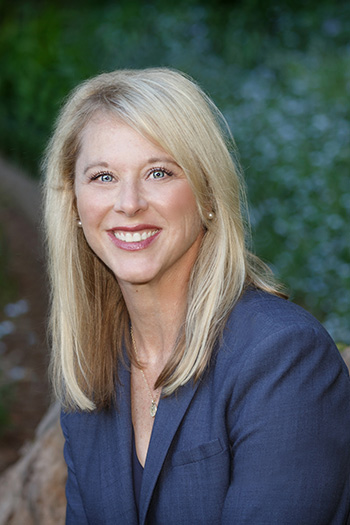
It used to be that the status quo was the way to go. It kept your company running. And it kept you employed. But in a world that changes at the speed of a TikTok, standing still makes you a sitting duck. Volatility lurks around every corner. Startups have become rockstars. Founders are celebrities. Customers are fickle. Employees are leaving. Disruption is inevitable. But if anyone’s going to disrupt your industry, your company, or your team, shouldn’t it be you?
As the world’s leading Innovation Architect, Carla Johnson’s been breaking the status quo all her life. In 20 years of working with leaders, she’s learned that the safest bet is often the riskiest move. Through years of research and authoring numerous best-selling books, she’s developed frameworks and processes that teach people how to redefine what innovation means in their organization, and then equips teams to make innovation everybody’s business.
Carla’s approach transforms organizations by fusing visionary creativity with pragmatic innovation
strategies to inspire teams to think bigger and bolder so they can bust out of the status quo. This
ultimately leads to inspired thinking and audacious outcomes. The result is a company culture that
becomes a playground of limitless potential while also experiencing unprecedented growth and
alignment.
July 30 | 9:15 AM
This general session presents key findings from UPCEA’s 2026 Benchmarking Online Enterprises Survey (BOnES), offering a comprehensive look at how institutions are structuring, funding, and scaling their online enterprises. Drawing on data from decision-makers across institutional, college, and unit levels, the presentation will explore critical dimensions such as organizational placement, administrative and academic decentralization, scope of responsibilities, program portfolios, and evolving financial models—including budgeting approaches, revenue sources, and fee structures . Attendees will gain insight into how institutions are resourcing online operations, responding to competitive pressures, and aligning strategy with institutional priorities.
Following the presentation, a panel of experienced leaders will reflect on the findings, highlighting the most consequential data points for senior leadership and discussing how these insights can inform decision-making at the provost and presidential level. The session is designed to move beyond reporting results to interpretation and application, helping attendees identify what matters most for their own context and how to translate benchmarking data into actionable strategy.






July 30 | 2:30 PM
Artificial intelligence is rapidly reshaping how institutions recruit, teach, support learners, and scale online education. Drawing on insights from AI Applications in Online Higher Education Administration (Routledge), this mainstage panel brings together three leading voices in digital learning to examine how AI is evolving from experimentation to institutional strategy.
Panelists will discuss AI's impact across the student lifecycle, from enrollment and onboarding through student success, instructional design, and institutional operations. The conversation will explore both the opportunities and the practical challenges institutions face, including governance, organizational readiness, and demonstrating return on investment. Attendees will also hear real-world examples of how institutions are putting AI into practice today.
Designed for senior leaders, this session focuses on the strategic choices that shape successful AI adoption. Panelists will discuss how institutions can align AI initiatives with their mission, strengthen internal capacity, and build a foundation for long-term transformation. Attendees will leave with a clearer understanding of where AI is delivering value today and how to position their institutions to lead with confidence.

Phil Ice is Chief Data Scientist & Head of Product for CampusLens at CampusWorks, where he defines the enterprise analytics strategy, leads cross-functional AI development teams, and oversees ethical AI frameworks aligned with FERPA, GDPR, and SOC 2. With over 25 years of experience in higher education and ed-tech, he brings a unique blend of pedagogical expertise and advanced data science to improve student outcomes and institutional ROI. Phil formerly served as Vice President of Research & Development at American Public University System, where he pioneered scalable learning analytics models, and as Chief Solutions Officer at Analytikus, guiding the creation of AI tools used by institutions across the Americas.

Dr. Lance Eaton is the Senior Associate Director of AI in Teaching and Learning at Northeastern University. He has earned a Master's in American Studies (UMASS Boston), Public Administration (Suffolk University), and Instructional Design (UMASS Boston). He completed his Ph.D. in Higher Education (UMASS Boston) with a focus on academic piracy and how scholars navigate the privatization of research literature in the 21st century.
His work engages with the possibility of digital tools for expanding teaching and learning communities while considering the profound issues and questions that educational technologies open up for students, faculty, and higher ed as a whole. He has engaged with scores of higher education institutions about navigating the complexities and possibilities that generative AI represents for us at this moment. His musings, reflections, and ramblings on AI and Education can be found on his blog: https://aiedusimplified.substack.com/

Claire Baytas is a Senior Analyst at Ithaka S+R, a research and strategy-focused division of the non-profit ITHAKA. At Ithaka S+R, Claire has spent the past three years leading and contributing to projects focused on generative AI’s impacts on postsecondary teaching, learning, and research; defining and implementing AI literacy; the status of the academic humanities; and other topics related to the academic mission and research enterprise in the context of higher education. Prior to joining Ithaka S+R, Claire completed a PhD in Comparative Literature at the University of Illinois Urbana-Champaign.
July 31 | 11:00 AM
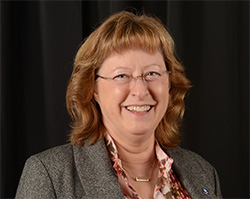
How does an institution transform into a national leader in online learning? That is the question posed by journalist Margaret Moffett in a new book on the SNHU transformation story, The Business of Hope: How SNHU Disrupted Higher Ed and Democratized Online Learning. In this candid fireside chat, Paul LeBlanc, former president of Southern New Hampshire University, joins journalist Margaret Moffett, currently chronicling SNHU’s evolution, to unpack the pivotal decisions, risks, and leadership approaches that fueled one of higher education’s most notable transformations.
Together, they will explore how SNHU built and scaled its online enterprise, including the strategic bets, organizational shifts, and cultural changes required to move from experimentation to sustained growth. The conversation will surface lessons on leading through ambiguity, aligning mission with market opportunity, overcoming mistakes and stumbles, and building the operational capacity needed to serve learners at scale.
Designed for senior leaders and decision-makers, this session offers a rare, reflective look at what it actually takes to execute large-scale online learning —and what others can take away as they navigate their own paths to scale.
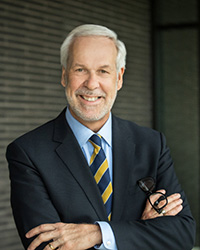 Visiting Scholar and Special Advisor, Harvard University Graduate School of Education
 Author, The Business of Hope: How SNHU Disrupted Higher Ed and Democratized Online Learning, and Journalist
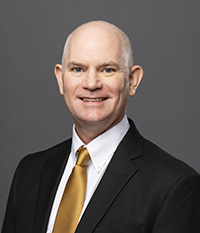 Vice Provost for Digital Learning at University of Central Florida